
Tech News Roundup — September 13, 2026 (PM)

Apple’s autumn hardware refresh dominates the week’s consumer news, but the sharpest stories sit underneath: Anthropic has named seven China-based AI labs it says ran industrial-scale distillation against Claude, and Linux’s next release retires a filesystem that survived two decades of out-of-tree life. Meanwhile, a new study argues that the solar boom has an expiry date, and the FTC’s data-broker crackdown on cars is still reshaping what connected vehicles are allowed to sell.
Apple launches iPhone 18 Pro, new watches and AirPods 5

New tech season is here. Apple has formally debuted the iPhone 18 Pro and iPhone 18 Pro Max alongside a refreshed Apple Watch lineup and AirPods 5, opening the autumn release cycle that the company typically uses to reset its product stack. Coverage this week focused on the two-model “iPhone Duo” positioning at the top of the range, with pre-order stock already split between configurations that will and will not arrive on launch day. MacRumors reports that AirPods 5 ship alongside the phones in September, with an OLED-equipped iPad Mini following in October — a staggered rollout that spreads the quarter’s hardware announcements across two months. Apple has also raised prices on previous-generation iPhones, making the older models more expensive now than they were at launch, a move that pushes buyers toward the new tier.
Anthropic accuses Chinese AI labs of mass Claude distillation
Anthropic has published detailed findings on what it calls industrial-scale distillation campaigns run by Chinese labs against Claude. The company’s misuse report names seven China-based AI firms, with TechCrunch reporting that Alibaba, Moonshot AI and DeepSeek are among them, and claims some labs secretly diverted their own users’ requests to Claude to harvest high-quality outputs for training. Business Insider puts the volume at least 35 million routed requests over the summer alone, while the South China Morning Post describes the same pattern of user prompts being quietly forwarded to a competitor’s model. Anthropic’s report also covers disruption of bioweapons-related research and Russian hacking activity alongside the distillation campaigns, framing model theft and malicious misuse as facets of the same monitoring problem. Distillation of a rival’s outputs is technically difficult to police, and the disclosure is likely to sharpen the argument over whether regulators should treat model outputs as protected property.
Your car is still selling your data
Connected vehicles remain one of the most aggressive data-collection surfaces consumers own, and the enforcement is only now catching up. The Federal Trade Commission issued an unprecedented penalty against General Motors earlier this year — a five-year ban on selling customer data to consumer reporting agencies and third-party brokers — after the regulator found that the company’s OnStar service collected and sold geolocation data without proper consumer consent. For years GM logged behavioural signals such as how often drivers sped or whether they drove at night, then sold that profile onward. The question now is how much of the rest of the industry has quietly done the same, and how enforceable a single-company ban is against a business model built on selling vehicle telemetry.
Linux 7.4 retires the BFS filesystem
The BFS scheduler-era filesystem is being removed from the mainline kernel for Linux 7.4, the latest in a run of upstream file-system retirements as long-unmaintained code is pruned ahead of release. BFS, the Brain Fuck Scheduler’s associated file handling, has lived out of tree for years and never carried the maintenance weight needed to justify keeping it in mainline. Anyone still depending on it will need to pin an older kernel or carry the out-of-tree patches themselves.
ARCTIC dual-licenses its Linux fan controller driver
ARCTIC is re-licensing the Linux driver for its fan controller under BSD-2-Clause so the code can be ported to other operating systems. The driver is an unusual case: an enthusiast hardware vendor published open-source Linux support and got it mainlined before the product itself shipped, at a price point under $10. Dual licensing under a permissive BSD-2-Clause keeps the mainlined kernel driver intact while allowing reuse elsewhere — a model that removes the usual chicken-and-egg problem of waiting for community support after launch.
Shotwell 33 arrives with a GTK4 port
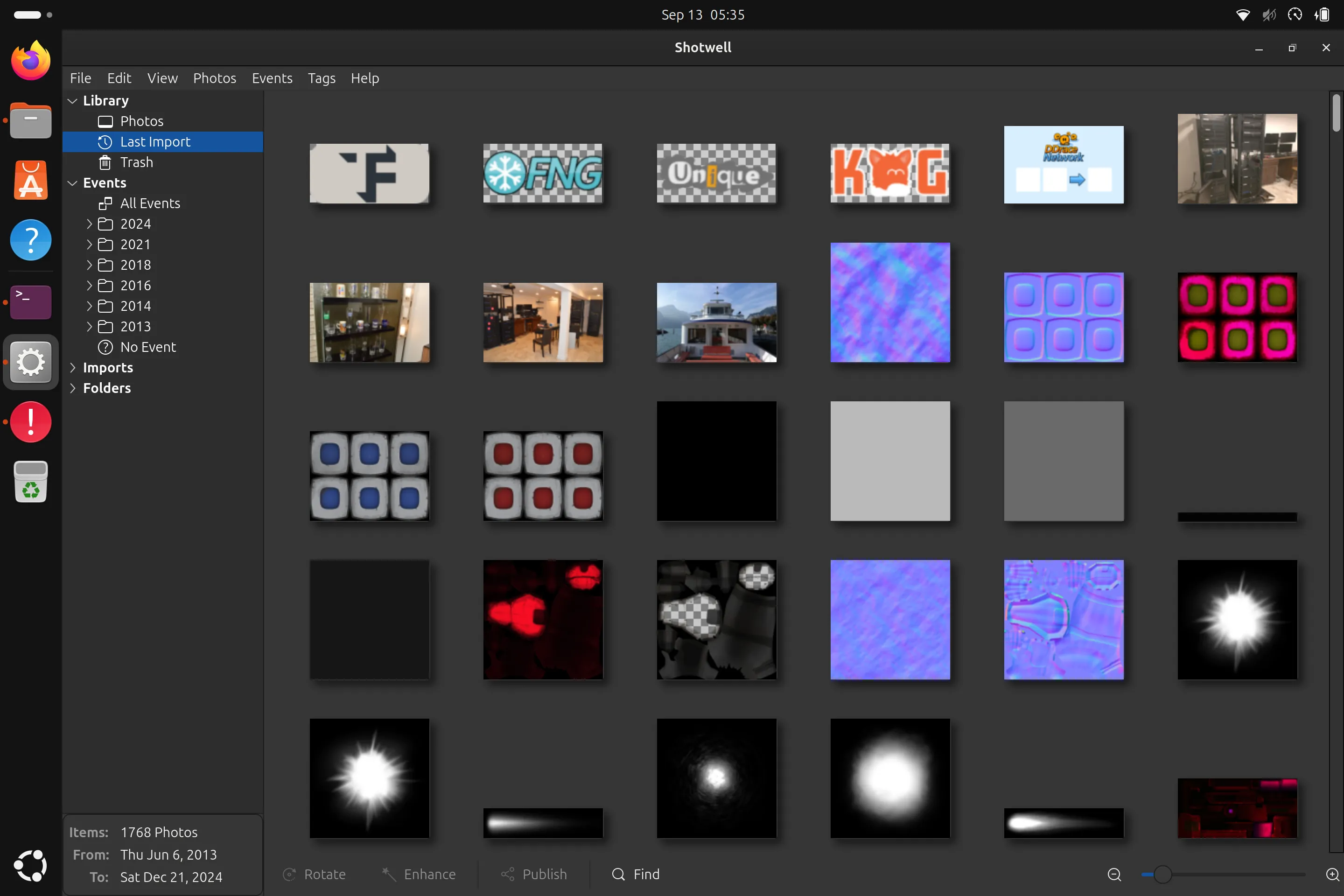
GNOME’s Shotwell photo manager has shipped version 33 with the long-awaited GTK4 port. It is the first significant release out of the project in some time, and the toolkit migration brings the photo organiser in line with the rest of the modern GNOME stack after years of lagging on GTK3. For a utility that many users keep installed mainly to import and catalogue camera photos, the port matters less for features than for staying viable on current desktops.
Solar’s end-of-life problem has a deadline: 2050

Solar panels do not last forever, and within a few decades the world will have to deal with millions of tonnes of end-of-life photovoltaic equipment. A research team has modelled the retirement wave and warns that the industry’s recycling capacity is not on track to absorb it, setting roughly 2050 as the point where decommissioned panel volumes become a large-scale waste problem. The panels are recyclable in principle, but the economics of recovering glass, silicon and silver from them still lag behind manufacturing new ones.
In Brief
- Why Wi-Fi dies in some walls. An explainer walks through how radio signals lose energy to absorption, reflection and diffraction — and why dense masonry or metal-backed plasterboard can kill a 5 GHz link that passes fine through a wooden partition.
- Anker’s non-charger catalogue. An overview of the company’s fast chargers, power banks and accessories for laptops and phones, beyond the cables and bricks most people know the brand for.
- Portugal’s childcare applications go online. Since 9 April 2026, requests for a Creche Feliz place are made exclusively through the Segurança Social portal rather than in person.
- 218 km/h on the A-62. A Portuguese driver was arrested in Spain after being clocked at 218 km/h near Carpio de Azaba in the province of Salamanca.
Compiled from the configured RSS feed.