From SMPTE 2110 Theory to PTP Practice with an AI Co-Engineer
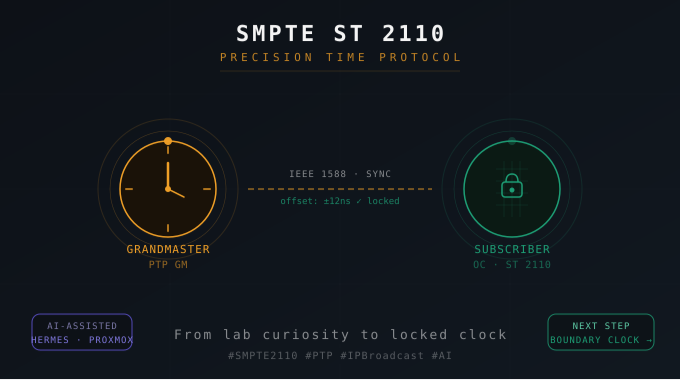
The broadcast industry’s shift to IP infrastructure built on SMPTE ST 2110 keeps surfacing one non-negotiable truth: PTP (Precision Time Protocol) is the bedrock. Without a solid timing foundation, your 2110 infrastructure is nothing more than expensive cable art.
As someone who tends to learn by doing, I spun up a few VMs on my home Proxmox server to build a PTP Grandmaster and Subscriber setup from scratch. Educational, hands-on — and honestly a lot of fun.
But since we’re also living through the “AI for everything” moment, I decided to add a twist: could an AI agent actually help me build this?
I set up Hermes — connected to Telegram, running on DeepSeek V3’s free tier — and gave it access to my Proxmox environment. Then I just… told it what I wanted.
Here’s what happened:
- It walked me through the Proxmox API permissions setup when I hit access issues
- It created the VMs autonomously
- It configured the PTP Grandmaster and Subscriber services
- When the offset was large and growing, it diagnosed the problem itself, adjusted the config on both VMs, restarted the services — and got PTP locked
- It handled troubleshooting whether I pasted terminal output or dropped in a screenshot — both worked seamlessly
- When it was done, I asked it to generate an
.mdfile with every command and configuration it had used — instant, clean documentation ready for my knowledge base
The whole thing took under an hour.
And now? It’s suggesting I implement a Boundary Clock as the logical next step. Which, honestly, is exactly the right call.
So what did I actually learn?
Honestly? Not that much — the AI did most of the heavy lifting. But that’s almost the point. I now have a working PTP setup I can dig into at my own pace, reverse-engineer, and actually understand. The AI got me past the blank-page problem. The learning happens from here.
I’ll be the first to admit: I’m late to the AI game. But after this experience, I’m genuinely excited to see what this technology can do — not just in the lab, but in how we as broadcast engineers approach complex infrastructure challenges. And I’m only getting started: next up is experimenting with local models running on my own GPU, and pushing further with more powerful online models like ChatGPT or Claude. If this is what a free model can do, I can’t wait to see what the big ones are capable of.
The future of broadcast is IP. And the future of building that infrastructure might involve a lot more conversations with your terminal.
Anyone else experimenting with AI-assisted lab setups? What are you using, and what surprised you?
#SMPTE2110 #BroadcastTech #PTP #IPBroadcast #AITools #Hermes #Proxmox #MediaAndEntertainment #BroadcastEngineering
P.S. — In the spirit of full transparency: this post was drafted with the help of AI too. If you’re going to write about AI doing your lab work, you might as well go all in.
Originally published on LinkedIn.